I remember the first time I heard about a physicist who also studied telepathy. It was at a small conference on anomalous phenomena, and the speaker was Irina Tsareva, a woman with a physics degree, a psychology degree, and a deep curiosity about the unexplainable. Her story, as she tells it in an old issue of Stupeni Orakula, is a testament to the idea that science and mystery are not always opposites.
Tsareva admits she was never a keen student. She disliked the endless repetition of dogmas in her institute. But after joining a laboratory at an academic institute, she encountered something that changed her worldview: secret research on telepathy, conducted without the knowledge of higher-ups. The whispers from the smoking rooms and the rumors floating through the corridors made her question the absolute certainty of scientific materialism.
This is not an uncommon experience. Many researchers in the Soviet era and beyond have found themselves drawn to the edges of science, where phenomena like telepathy, precognition, and dowsing refuse to fit neatly into established theories. Tsareva's journey, however, took her further than most.
The Razor's Edge Between Science and the Supernatural
Tsareva describes her path as walking a razor's edge, the boundary between opposing approaches to understanding the universe. She felt that the truth lay somewhere in between, but to walk that edge, she needed more knowledge. So she went back to school, earning degrees in physics and psychology. Eventually, she also obtained an international diploma in parapsychology.
Interestingly, despite mastering magical techniques, she never felt comfortable performing "passes" over someone's head. For her, the knowledge was a way to avoid criticizing something she didn't understand. This humility is rare in both scientific and esoteric circles. She wanted to understand anomalous phenomena from the inside, not just dismiss them or blindly accept them.
In folklore and traditional beliefs, the figure of the wise person who understands both natural and supernatural realms appears often. In Slavic tradition, there are znakhari (healers) who use herbs and prayers, blending folk medicine with Christian elements. Tsareva's approach echoes this: she uses scientific methods to study phenomena that folklore has long described, like the mysterious "witch circles" that appear in fields.
The Mystery of Witch Circles: A Scientific Explanation
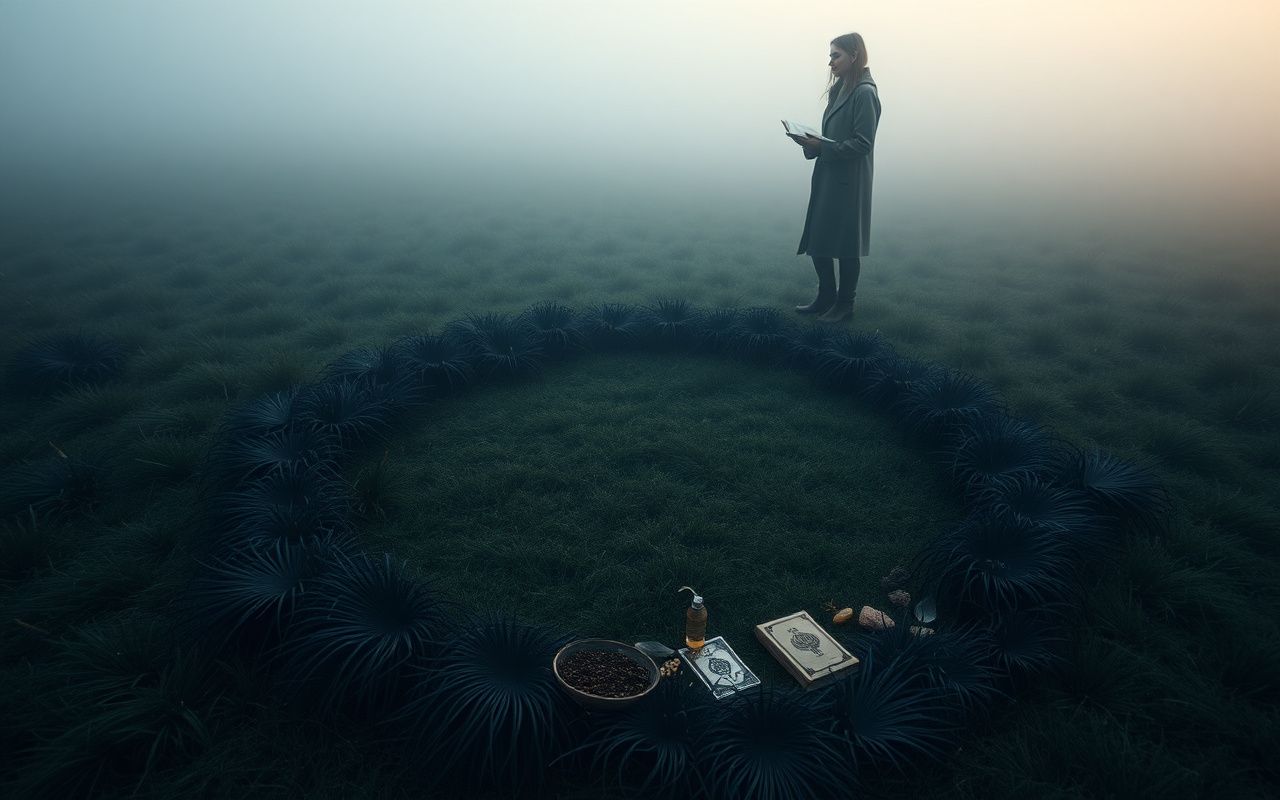
One of Tsareva's most notable works is the book The Secret of Witch Circles, co-authored with Igor Tsarev. In 2005, it received a diploma from the Vernadsky Foundation for providing a natural-scientific explanation of a mysterious natural phenomenon. Witch circles (rings of mushrooms or dead grass) have been part of European folklore for centuries, often associated with fairy dances or witches' gatherings.
Tsareva's research suggests that these circles may have a natural cause, possibly related to fungal growth patterns or soil chemistry. But her work doesn't dismiss the folklore. Instead, it seeks to understand the phenomenon behind the stories. This is a delicate balance, one that requires respect for both scientific evidence and cultural traditions.
I find this approach refreshing. As someone who reads tarot and studies astrology, I often encounter people who want either hard proof or blind faith. But there is a middle path: acknowledging that some phenomena may have natural explanations while also recognizing that our ancestors observed real patterns and wove them into stories. The witch circles are a perfect example. Whether they are caused by fungi or fairies, they have captured human imagination for centuries.
Why This Matters for Modern Seekers
Tsareva's story is a reminder that the line between science and spirituality is not always clear. In the 1970s, when the information boom around anomalous phenomena began in the USSR, many scientists were forced to confront the limits of materialism. Today, we have a similar moment with the rise of interest in consciousness studies, parapsychology, and alternative healing.
For those of us who practice divination (whether tarot, runes, or I Ching), there is a lesson here. We don't have to choose between being rational and being open to mystery. We can walk the razor's edge, using our intellect to question and our intuition to explore. Tsareva's "Phenomenon" association aims to share observations and conclusions, not to preach dogmas. That is a model worth following.
I have often felt the tension between my scientific training and my esoteric interests. When I first started reading tarot, I worried that I was being irrational. But over time, I realized that the cards are a tool for reflection, not a source of absolute truth. Similarly, Tsareva's research into witch circles or telepathy does not claim to have all the answers. It simply asks questions and shares findings.
Perhaps the most important thing is to keep an open mind and a critical eye. As Tsareva quotes the ancient philosopher: "I know that I know nothing." That humility is the starting point for any genuine exploration, whether in science or in the mysterious.
For entertainment purposes only.