I remember flipping through a worn book of Slavic folklore and stumbling upon a series of incantations meant to heal everything from toothaches to exhaustion. The words felt both foreign and familiar, like a half-remembered dream. In Russian folk tradition, healing spells (often called zagovory) were passed down through generations, blending Christian imagery with older pagan elements. Today, we explore these rituals not as medical advice, but as a window into how our ancestors understood health and the supernatural.
The Structure of a Healing Incantation
Most Russian healing spells follow a distinct pattern. The speaker begins by stating their intention, often invoking a higher power. For example, one incantation for overall health starts: "I will rise, the servant of God, praying and crossing myself." This opening frames the act as sacred, a plea for divine protection.
The spell then describes a journey: leaving the house, walking into an open field, and washing with dew. These steps are symbolic. They represent a transition from the mundane to the magical. The field is a liminal space, neither home nor wilderness, where the supernatural can be accessed. The speaker meets an angel (often the Archangel Michael) and asks for the body to be made "stronger than steel, harder than lead." This metaphor of hardening the body against illness is common in Slavic folk medicine.
Another spell, designed to prevent illness during epidemics, instructs the practitioner to recite words each morning after waking. It calls upon Saint Panteleimon, a Christian healer, to "remove fatigue and disease from body and soul." The blend of Christian saints with pre-Christian ritual elements shows how folk practices adapted over centuries.
Rituals for Specific Ailments
Some spells target specific problems. For toothache, the ritual involves looking at the moon and speaking to it: "The old moon came to the new moon and said: 'You and I have no toothache, so may (name)'s gums and teeth not ache or hurt.'" The moon, a powerful symbol in Slavic folklore, is treated as a living entity with whom one can negotiate. The spell ends with "Key, lock, tongue. Amen." This triple seal is meant to lock the words into reality.
For a twitching eyelid, the remedy is surprisingly simple: brew three geranium leaves in water and drink the infusion over a day. Alternatively, one can hold the eyelid with the little finger of the left hand and repeat three times: "A dead horse does not gallop." The absurdity of the phrase is part of its power. It breaks the mind's pattern and asserts the end of the twitch.
The ritual for chronic weakness is particularly evocative. On a Sunday at noon, the healer lights a red and a green candle, seats the patient facing east, and intones: "Do not groan, do not be ill, do not suffer. His body is blood and milk, his arms and legs filled with strength." The colors of the candles likely carry symbolic meaning: red for vitality, green for health. The patient faces east, the direction of the rising sun and new beginnings.
The Tree Ritual: Transferring Illness to Nature
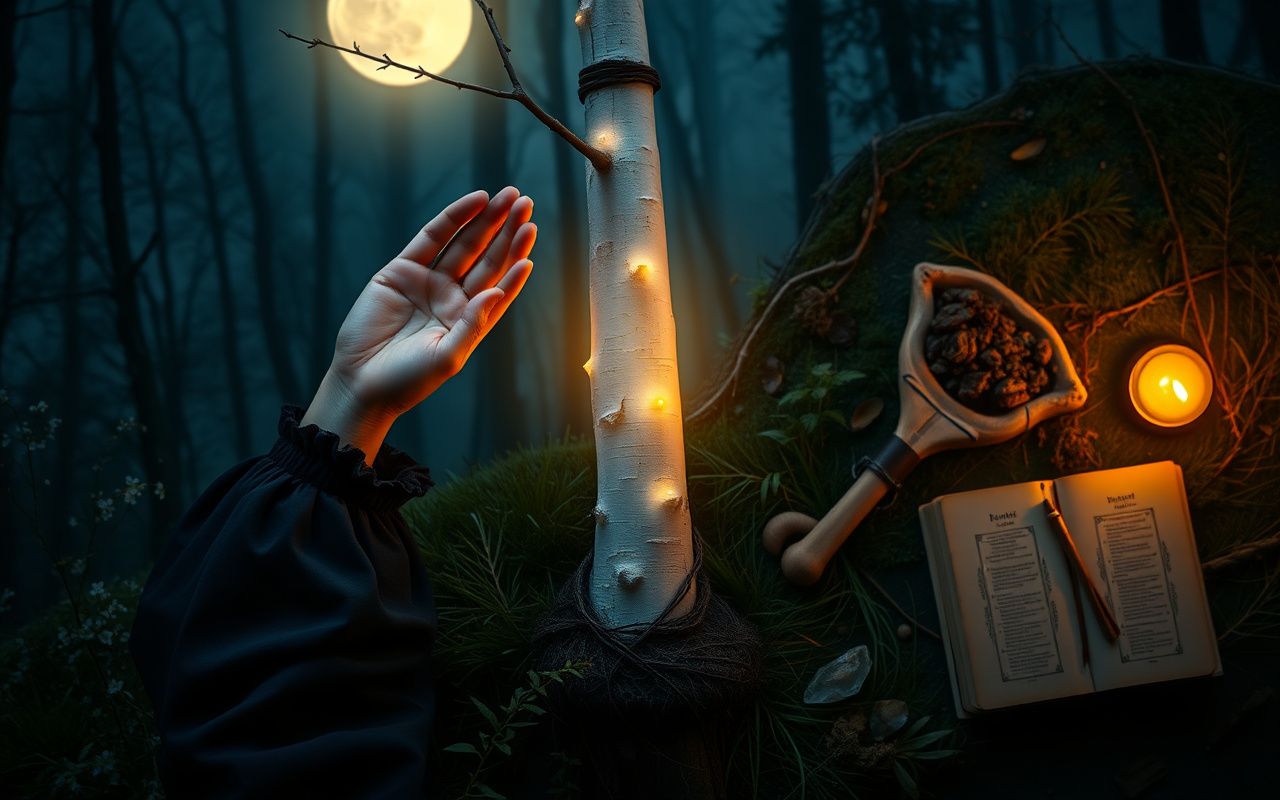
One of the most striking practices involves transferring sickness to a young tree. At night, the afflicted person goes to a forest or park, places both palms on the trunk, and visualizes warmth flowing from the bark into their hands. Then they recite: "Burning illness, prickly sickness, reaches for the tree, passes from my body to the roots. Not the servant of God will suffer, but the tree will wither."
After a few weeks, the healer checks the tree. If it has dried up or its leaves have yellowed, the illness is believed to have left the person. This ritual reflects a worldview where nature is not separate from human health but deeply interconnected. Taking illness into oneself is seen as a sacrifice. The tree becomes a willing participant, or a victim.
These practices are part of a broader Slavic folk magic tradition that persisted well into the 20th century. Ethnographers like Vladimir Dal collected hundreds of such spells in the 19th century, noting their use in villages across Russia. While modern medicine has replaced these rituals for most people, they remain a fascinating cultural artifact. They show how our ancestors made sense of suffering and sought control over the unpredictable forces of disease.
For entertainment purposes only.